Choose an LED street light by the required illumination and distribution, not wattage alone. Wattage measures electrical input; useful road lighting also depends on lumen output, optical distribution, mounting height, pole spacing, road width, surface conditions and maintenance. A 50 W fitting is not automatically the correct choice for every road or compound.
Quick selection answer
Use 24 W as a starting comparison for smaller compounds, pathways or lower-output local lighting points. Consider 50 W for wider compounds, local roads and commercial outdoor areas that need more output. Consider 72 W where the mounting geometry and required coverage justify higher output. These are comparison starting points, not photometric design guarantees.
The final choice should be checked using the manufacturer's lumen and beam data or a lighting calculation for the actual site.
Why watts are not enough
Watts describe input power. Lumens describe emitted visible light, and lux describes how much light reaches a surface. The U.S. Department of Energy recommends comparing lumens when judging brightness. For outdoor installations, light distribution and fixture spacing determine whether those lumens reach the road evenly.
Two LED street lights with the same wattage can perform differently because of differences in LED efficacy, driver losses, lenses, housing temperature and optical control. Ask for these details where available:
- rated input wattage;
- initial lumen output;
- luminaire efficacy in lumens per watt;
- beam or roadway distribution;
- colour temperature and colour-rendering information;
- surge protection and driver details;
- ingress-protection rating for the complete fitting;
- warranty terms and test reports.
Comparing 24 W, 50 W and 72 W street lights
| Catalog option | Useful starting application | Confirm before selection |
|---|---|---|
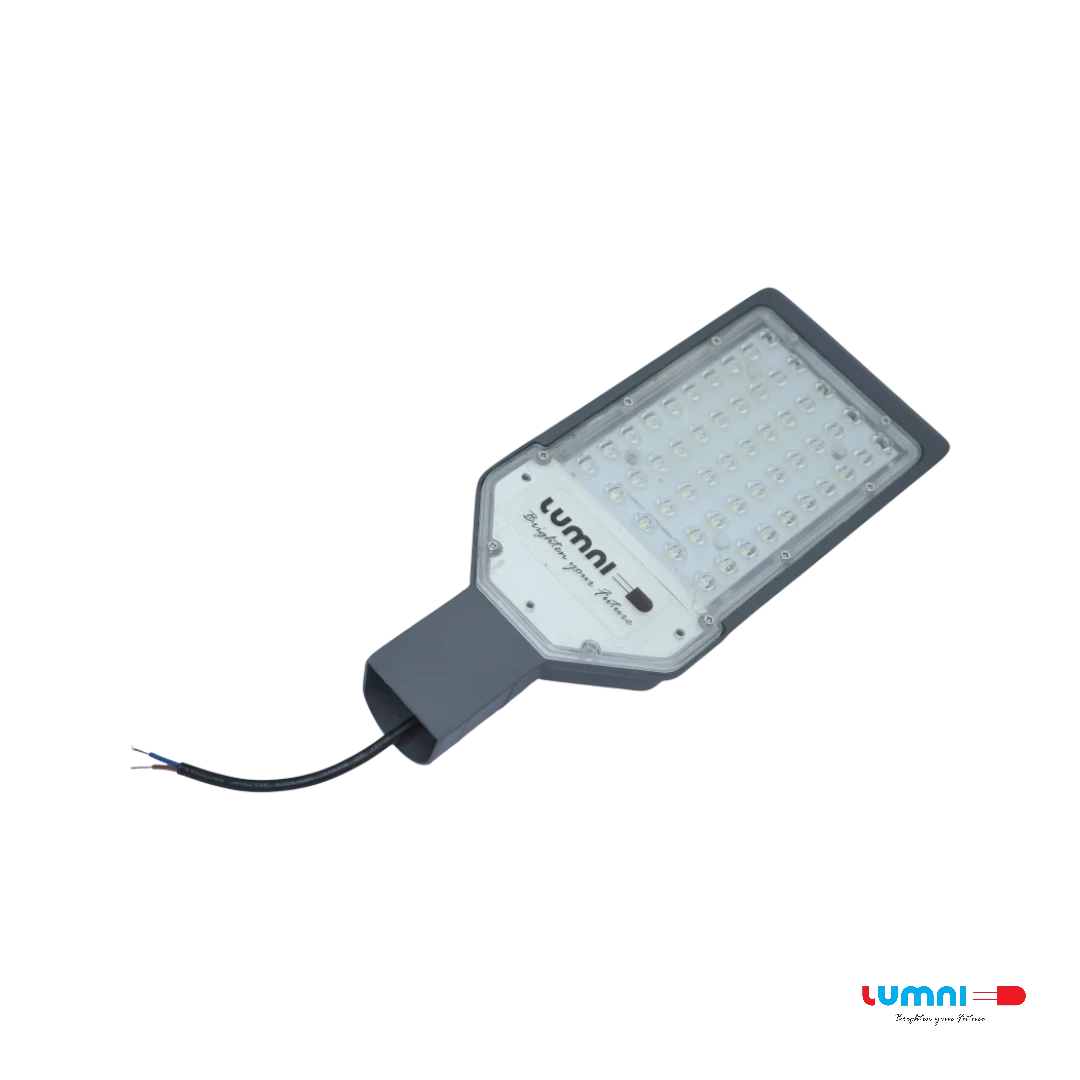
| LED Street Light 24 W | Pathways, smaller compounds and local outdoor points | Pole height, spacing, lumen output and required coverage |
| LED Street Light 50 W | Local roads, compounds and commercial outdoor areas | Road width, beam distribution, glare and uniformity |
| LED Street Light 50 W Hole Model | Applications requiring the compatible hole-model mounting format | Mounting dimensions and pole-arm compatibility |
| LED Street Light 72 W | Wider or higher-output outdoor applications | Photometric calculation, mounting height and electrical protection |
Do not select a higher wattage only because it appears brighter. Excessive intensity can create glare, strong contrast and wasted upward or sideways light while still leaving dark areas between poles.
Site information needed for accurate selection
Measure or record the following before requesting a quotation:
- Road, driveway or compound width.
- Existing or proposed pole height.
- Distance between poles.
- Whether lights are installed on one side, both sides or in a staggered layout.
- Traffic type and expected night-time activity.
- Nearby homes, windows or drivers that may experience glare.
- Supply conditions, switching method and surge environment.
- Required operating hours and maintenance access.
India's Bureau of Energy Efficiency street-lighting guidance separates roads by traffic and recommends considering average illuminance, minimum-to-average uniformity and luminaire type. It also notes that lumen depreciation and dirt depreciation affect maintained output. See the BEE Energy Efficient Street Lighting Guidelines for the planning framework.
Pole height, spacing and uniformity
A higher pole can spread light over a wider area, but the fitting must provide enough output and the correct beam distribution. Wider spacing reduces the number of poles but can create dark gaps. Closer spacing can improve uniformity while increasing equipment and installation cost.
Uniformity matters because drivers and pedestrians adapt poorly to alternating bright and dark patches. A suitable layout balances average light level with the darkest relevant areas. For road projects, use photometric data and a competent lighting designer rather than relying on a wattage table.
Glare and light direction
Glare can reduce comfort and visibility even when measured light levels are high. Keep the bright LED source outside normal lines of sight where possible, use suitable optics and avoid unnecessary tilt that sends light into windows or the sky. Signify's technical overview of glare in exterior applications explains that outdoor glare depends on the luminaire, environment and observer position.
Controls and maintenance
An automatic day-night controller can prevent street lights from operating unnecessarily in daylight. Browse the LDR sensor cover and module-type LDR sensor with cover for compatible control applications. Confirm that the controller is rated for the connected load and installation environment.
Plan for periodic cleaning because dust on the optical surface reduces useful output. Inspect pole fixings, cable entries, earthing, surge protection and driver condition during maintenance. Work at height and electrical servicing should be performed by trained personnel using appropriate isolation and access equipment.
Final answer
Choose between 24 W, 50 W and 72 W only after checking lumen output, road width, pole height, spacing, beam distribution, glare and maintained illumination. For small outdoor points, start by evaluating 24 W; for local roads and compounds, compare 50 W; for higher-output layouts, evaluate 72 W with photometric data. Send the site dimensions, pole arrangement, quantity and delivery location through the Lumni Power Tech contact page for product and project guidance.